MOSIP Compliant Fingerprint Scanner: How It Works, Security Risks & Best Solutions
Updated: Apr 25
What is MOSIP Compliant Fingerprint Scanner?
A MOSIP compliant fingerprint scanner is a biometric device designed for secure digital identity systems such as national ID, border control, and eKYC verification.
These scanners must meet strict MOSIP standards to ensure high accuracy, anti-spoofing capability, and reliable identity authentication.

Why Biometric Security Matters
With the rapid growth of digital identity systems, biometric authentication has become a critical component in ensuring secure access and identity verification.
Fingerprint recognition is one of the most widely used biometric technologies due to its:
High accuracy
Ease of use
Cost efficiency
However, traditional fingerprint technologies are facing increasing security challenges, especially in high-risk environments such as national ID systems, border control, and financial services.

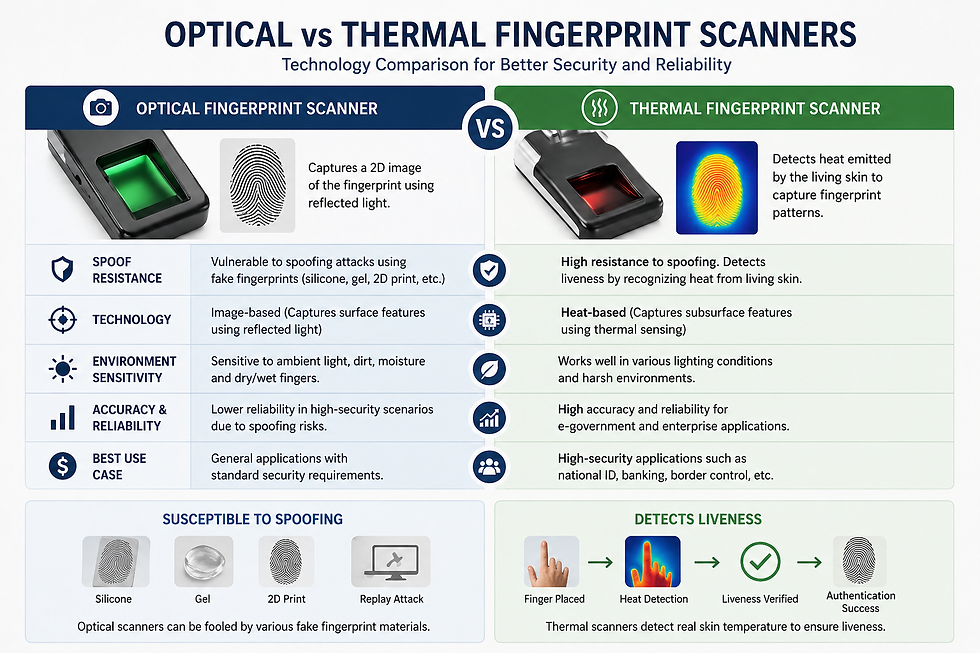
Limitations of Optical Fingerprint Scanners
Optical fingerprint scanners have been widely used for many years, but they come with several limitations:
1. Vulnerability to Spoofing
Optical sensors can be tricked by fake fingerprints made from silicone, gelatin, or printed images.
2. Surface-Level Detection
They capture only the surface image of a fingerprint, making them less reliable in detecting liveness.
3. Environmental Sensitivity
Performance may be affected by lighting conditions, dirt, or moisture on the finger.
These limitations make optical scanners less suitable for high-security applications, especially those requiring strict compliance with MOSIP standards.

Thermal Fingerprint Technology: A More Secure Approach
To address the limitations of optical sensors, advanced fingerprint technologies such as thermal sensing have been developed.
Thermal fingerprint scanners work by detecting heat differences between the ridges and valleys of a fingerprint. This enables:
Better liveness detection
Strong resistance to spoofing attacks
More stable performance across environments
Compared to optical solutions, thermal technology provides a higher level of security and reliability, making it more suitable for government and enterprise-level applications.

Optical vs Thermal Fingerprint Scanners
How to Choose a MOSIP Compliant Fingerprint Scanner
When selecting a fingerprint scanner for MOSIP-based systems, consider the following factors:
Compliance Certification: Ensure the device meets MOSIP standards
Anti-Spoofing Capability: Ability to detect fake fingerprints
Durability: Suitable for long-term and large-scale deployment
Integration Flexibility: Compatibility with existing systems
Choosing the right device is essential to ensure both security and scalability.
Devices like EKEMP EM62 provide advanced thermal sensing technology, making them suitable for government and enterprise biometric systems.

Advanced Solutions for MOSIP Applications
To meet the growing demand for secure biometric authentication, advanced fingerprint solutions have been developed using innovative technologies.
For example, solutions like EKEMP EM62 fingerprint scanner utilize active thermal sensing technology to enhance anti-spoofing capabilities and meet MOSIP compliance requirements. These devices are designed for high-security scenarios such as national ID programs and identity verification systems.
👉 Learn more about the EM62 fingerprint scanner: https://www.ekemp.com.cn/mosip-compliant-secure-fingerprint-scanner

Conclusion
MOSIP compliant fingerprint scanners play a crucial role in building secure and scalable digital identity systems. While traditional optical technologies have limitations, newer approaches such as thermal sensing provide stronger protection against spoofing and improve overall system reliability.
As biometric security requirements continue to evolve, adopting advanced fingerprint technologies will be key to ensuring long-term success in identity management.
Key Takeaways
- MOSIP compliant fingerprint scanners are essential for secure digital identity systems
- Optical fingerprint scanners are vulnerable to spoofing attacks
- Thermal fingerprint technology provides better anti-spoofing and liveness detection
- Choosing the right biometric device ensures long-term security and system reliability
If you are looking for more MOSIP compliant products, you can find biometric enrollment kit, biometric tablet on EKEMP.