Biometric Identity Verification for National ID, eKYC and Digital Public Infrastructure
Updated: Jun 17

Biometric identity verification is used to confirm that a person is who they claim to be by using unique biological traits such as fingerprints, face, iris or palm vein patterns.
For governments, banks, telecom operators and public service providers, it is becoming an important part of digital identity systems, eKYC, voter registration, border control and Digital Public Infrastructure.
This guide explains how biometric identity verification works, the main technologies involved, common use cases, security risks and what organizations should consider before deploying a biometric identity system.
What Is Biometric Identity Verification?
Biometric identity verification is the process of confirming a person’s identity using biological or behavioral traits that are unique to the individual.
Unlike passwords or physical documents, biometric identifiers are difficult to duplicate, transfer, or steal.
Common biometric identifiers include:
Fingerprints
Facial features
Iris patterns
Palm veins
Voice characteristics
Behavioral patterns
A biometric system captures biometric data, converts it into digital templates, and compares the information against stored records for authentication or identification.
Biometric verification is commonly used in:
National ID registration
Border control
Banking and fintech
Mobile authentication
Healthcare systems
Digital public infrastructure (DPI)
Access control
Voter registration
SIM card registration
How Biometric Identity Verification Works
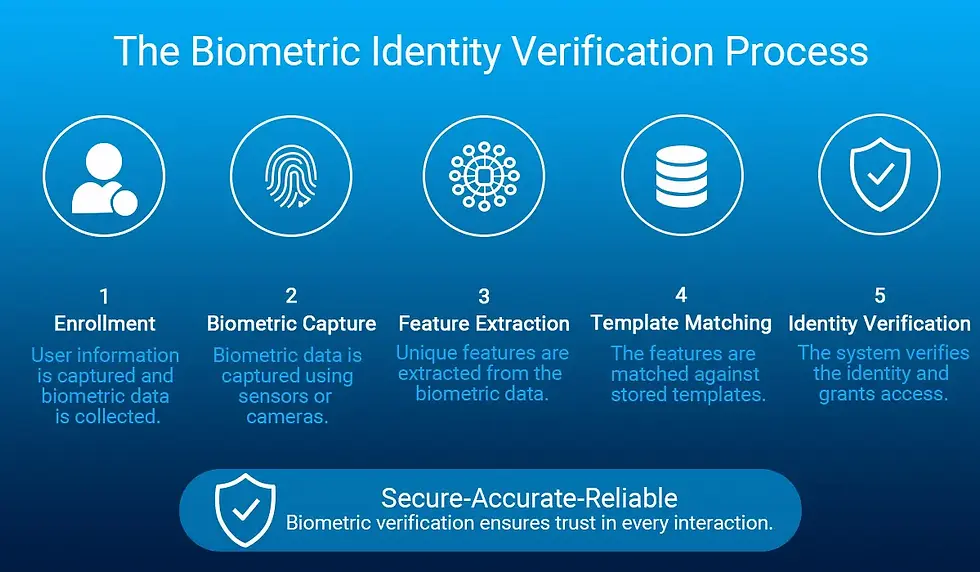
A typical biometric identity verification process includes several stages.
1. Enrollment
During enrollment, the system captures biometric data such as a fingerprint or facial image.
The system extracts distinctive features and converts them into encrypted biometric templates.
These templates are then securely stored in:
Centralized databases
Secure servers
Mobile devices
Smart cards
Identity management systems
2. Capture
When a user attempts authentication, the biometric device captures new biometric data.
For example:
A fingerprint scanner captures ridge patterns
A facial recognition camera captures facial geometry
An iris scanner captures iris texture patterns
3. Feature Extraction
The system extracts unique biometric characteristics from the captured data.
4. Matching
The captured biometric template is compared with stored templates.
The system calculates a similarity score.
If the score exceeds a predefined threshold, authentication succeeds.
Major Biometric Verification Technologies
Fingerprint Recognition
Fingerprint recognition remains one of the most widely deployed biometric technologies.
Fingerprint scanners analyze:
Ridge endings
Bifurcations
Minutiae points
Ridge flow patterns
Advantages
Highly accurate
Mature technology
Fast authentication
Cost-effective deployment
Compact hardware integration
Common Applications
National ID enrollment
Banking authentication
Attendance systems
Border management
Mobile biometric terminals
Voter registration systems
Modern biometric terminals now support:
FBI-certified fingerprint modules
Slap fingerprint capture
Multi-fingerprint enrollment
Contactless fingerprint technology

Facial Recognition
Facial recognition technology identifies users through facial geometry and feature mapping.
AI-powered facial recognition systems can analyze:
Eye distance
Nose structure
Jawline shape
Facial landmarks
Skin texture
Advantages
Contactless authentication
Fast user experience
Ideal for remote onboarding
Scalable deployment
Common Applications
eKYC verification n- Mobile banking
Airport security
Smart city surveillance
Remote customer onboarding
Advanced systems now integrate:
Deep learning algorithms
3D face mapping
Infrared imaging
Active liveness detection

Iris Recognition
Iris recognition analyzes the unique patterns within the iris.
Iris biometrics offer extremely high accuracy because iris patterns remain stable throughout life.
Advantages
Extremely low false acceptance rates
High uniqueness
Contactless authentication
Suitable for large identity systems
Common Applications
Border control systems
National identity programs
High-security facilities
Healthcare identity systems
Palm Vein Recognition
PaIm vein recognition uses near-infrared imaging to identify individuals based on unique vein patterns beneath the skin of the palm.
Because vascular patterns are internal biological characteristics, palm vein verification offers strong resistance to spoofing and provides a highly secure authentication method.
Advantages
High anti-spoofing capability
Contactless authentication
Stable recognition performance
Strong security assurance
Common Applications
National ID programs
Banking authentication
Healthcare identification
Secure access control
As identity ecosystems evolve, palm vein recognition is becoming an important option for high-assurance biometric verification.
What Is Liveness Detection?

Liveness detection is a security mechanism that determines whether biometric samples originate from a real human being rather than spoofing artifacts.
As biometric adoption grows, spoofing attacks have become increasingly sophisticated.
Common spoofing methods include:
Printed face photos
Silicone fingerprints
Replay attacks
Deepfake videos
Synthetic voice attacks
Liveness detection helps prevent these attacks.
Types of Liveness Detection
Active Liveness Detection
Active liveness requires user interaction.
Examples include:
Blinking
Smiling
Head movement
Random facial gestures
Passive Liveness Detection
Passive liveness works automatically without user interaction.
AI algorithms analyze:
Skin texture
Light reflection
Depth information
Micro-expressions
Motion consistency
Passive liveness is increasingly preferred because it improves user experience.
Biometric Identity Verification Use Cases
National Digital Identity Programs
Governments worldwide are deploying biometric identity systems to establish trusted digital identity ecosystems.
Biometric identity programs support:
Citizen registration
Social welfare distribution
Digital public services
eGovernment systems
Voter registration
Border security
Large-scale digital identity initiatives often integrate:
Fingerprint enrollment
Facial verification
Deduplication systems
Identity authentication APIs
Banking & Financial Services
Financial institutions use biometrics to reduce fraud and streamline customer onboarding.
Biometric verification supports:
eKYC compliance
Remote account opening
Transaction authentication
Mobile banking login
Fraud prevention
Banks increasingly adopt facial recognition and liveness detection for secure remote onboarding.
Border Control & Immigration
Biometric systems are widely used in:
eGates
Airport immigration
Traveler verification
Visa enrollment
Refugee registration
Biometric border systems improve:
Processing speed
Security accuracy
Fraud prevention
Identity traceability
Healthcare Identity Management
Healthcare systems use biometrics to:
Prevent duplicate patient records
Improve patient identification
Protect medical data
Streamline hospital workflows
Biometric verification is particularly valuable in large public healthcare programs.
Telecom & SIM Registration
Telecom operators deploy biometric SIM registration systems to comply with national regulations and reduce fraud.
Biometric enrollment helps prevent:
SIM fraud
Identity theft
Fake registrations
Biometric Security Challenges
Despite the advantages of biometrics, organizations must address several security and privacy challenges.
Challenge | Description | Countermeasures |
Privacy Concerns | Biometric data is highly sensitive |
|
Spoofing Attacks | Fake fingerprints, Deepfake videos, Printed photos | Anti-spoofing technologies and liveness detection |
Data Breaches | biometric traits cannot easily be changed; a compromised biometric database may create long-term risks |
|
Environmental Limitations | Poor lighting;Wet fingers Low-quality cameras; Sensor contamination | Modern AI algorithms continuously improving robustness |
The Rise of Digital Public Infrastructure (DPI)
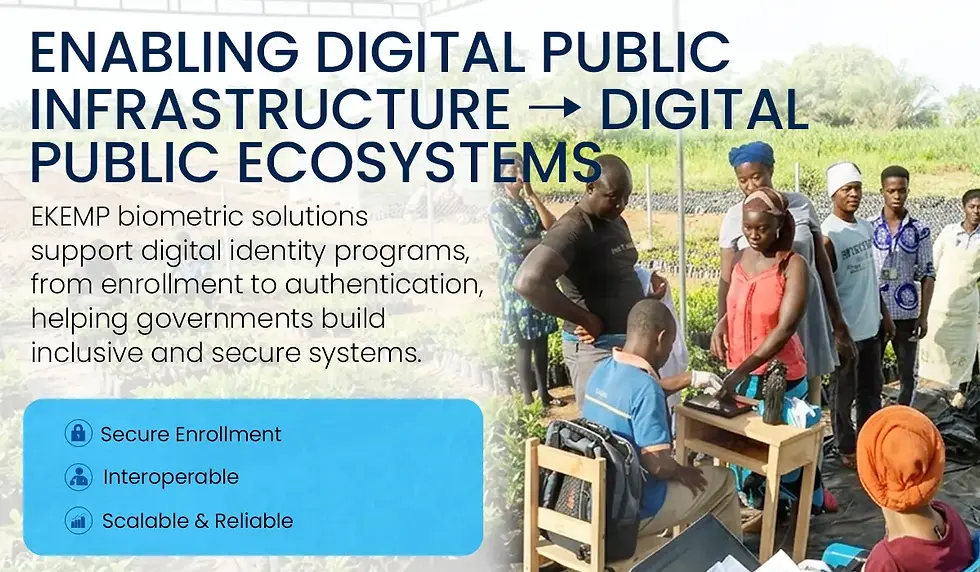
From Digital Identity to Digital Public Ecosystems
Biometric identity verification is no longer viewed as a standalone security capability. Around the world, governments and public institutions are integrating identity systems into broader digital transformation strategies.
This evolution was reflected in the central discussion at ID4Africa 2026:
Digital Identity: From DPI to Digital Public Ecosystems
The message is clear: digital identity is becoming the foundation of connected public services rather than an isolated government database.
Digital Public Infrastructure (DPI) refers to the foundational digital systems that enable governments to deliver trusted, accessible, and scalable services at national scale. Identity verification sits at the center of this infrastructure because every digital interaction begins with establishing trust.
Core DPI layers commonly include:
Digital identity systems
Authentication and access management
Secure payment infrastructure
Trusted data exchange mechanisms
Citizen service platforms
However, the next phase extends beyond infrastructure.
A Digital Public Ecosystem connects identity with multiple public and private services to create continuous, citizen-centered experiences.
Examples include:
Registering a newborn and automatically enabling healthcare access
Using national digital identity for banking onboarding
Connecting social protection programs with verified beneficiaries
Enabling secure border control and travel verification
Delivering government services through interoperable digital platforms
Within these ecosystems, biometric verification technologies provide a trusted bridge between physical identity and digital participation.
Modern biometric identity systems increasingly support:
Fingerprint verification
Facial authentication
Passive and active liveness detection
Multi-factor identity assurance
Online and offline enrollment workflows
Edge-based identity verification
As countries continue investing in digital transformation, identity systems are expected to become more interoperable, privacy-conscious, and service-oriented.
For technology providers, success will no longer be measured only by enrollment volume or authentication speed—but by how effectively identity enables broader digital public outcomes.
EKEMP supports this transition through biometric enrollment and verification technologies designed for large-scale identity programs and secure service delivery environments.
Future Trends in Biometric Identity Verification

AI, Interoperability, and Ecosystem Thinking
The future of biometric identity verification is increasingly shaped by artificial intelligence and ecosystem integration.
Emerging developments include:
AI-Enhanced Recognition
Machine learning models continue improving matching accuracy under challenging real-world conditions.
Passive Liveness Detection
Advanced algorithms reduce friction while helping prevent presentation and spoofing attacks.
Interoperable Identity Architectures
Identity platforms are evolving to support cross-system authentication and broader public service integration.
Privacy-by-Design
Organizations are placing greater emphasis on consent management, decentralized architectures, and secure data governance.
Edge Biometric Computing
Offline and low-connectivity environments increasingly rely on local processing for faster and more resilient verification.
As the industry moves from isolated identity programs toward connected Digital Public Ecosystems, biometric technologies are expected to become one of the core enabling layers of trusted digital infrastructure.
FAQ
What is biometric identity verification?
Biometric identity verification confirms a person's identity using unique biological or behavioral traits such as fingerprints, face, iris, palm veins, voice, or liveness signals.
How does biometric identity verification work?
A biometric system captures a biometric sample, extracts unique features, converts them into a digital template, and compares it with stored identity records.
Why is liveness detection important?
Liveness detection helps prevent spoofing by confirming that the biometric sample comes from a real, present person rather than a photo, video, mask, or synthetic artifact.
Where is biometric identity verification used?
It is widely used in national ID programs, eKYC, banking, telecom registration, border control, healthcare identity systems, voter registration, and secure access control.